
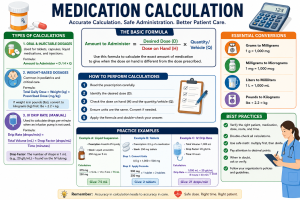
Medication calculation is a critical skill in healthcare that helps ensure patients receive the correct dose of medicine at the right time. Every day, nurses, pharmacists, and other healthcare professionals perform dosage calculations to prevent medication errors and support effective treatment outcomes. Understanding the principles behind medication calculation can improve confidence, accuracy, and patient safety in hospitals, clinics, pharmacies, and community healthcare settings.
Accurate drug dosing is not only important for treatment effectiveness but also for protecting patients from potential complications caused by incorrect medication administration. Whether calculating tablets, liquid medications, injections, or intravenous fluids, healthcare workers rely on proven formulas and methods to determine the correct amount to administer.
Why Accurate Dosage Calculations Matter
Healthcare professionals must perform calculations carefully because even a small mistake can have significant consequences. Medication calculation helps ensure that patients receive the intended therapeutic effect while minimizing the risk of adverse reactions.
Some key benefits of accurate dosage calculations include:
- Improved patient safety.
- Reduced medication errors.
- Better treatment outcomes.
- Increased professional confidence.
- Enhanced quality of healthcare services.
For students entering the healthcare field, mastering medication calculation is one of the most important competencies they can develop. Regular practice strengthens understanding and improves decision-making during patient care.
Understanding the Basic Formula
The most commonly used formula for medication calculation is:
Amount to Administer = (Desired Dose ÷ Dose on Hand) × Quantity
This formula allows healthcare professionals to determine exactly how much medication should be given to a patient. The desired dose refers to the amount prescribed by the healthcare provider, while the dose on hand represents the strength of the available medication. The quantity refers to the dosage form, such as one tablet or a specified volume of liquid.
For example, if a patient requires 500 mg of a medication and the available tablets contain 250 mg each, the calculation shows that two tablets are needed. This simple method forms the foundation of medication calculation in many healthcare environments.
Types of Medication Calculations
Different clinical situations require different calculation methods. Understanding these approaches helps healthcare professionals choose the correct formula for each scenario.
Oral and Injectable Dosages
This is the most common type of medication calculation and is used for tablets, capsules, syrups, suspensions, and injections. Healthcare providers compare the prescribed dose with the available dose to determine the amount needed.
Weight-Based Dosages
Many medications, especially those used in pediatric care, are prescribed according to body weight. In these situations, medication calculation involves multiplying the patient’s weight in kilograms by the prescribed dosage per kilogram.
Before performing the calculation, weight measurements in pounds must be converted to kilograms by dividing by 2.2. Accurate weight conversion is essential for safe dosing.
Intravenous (IV) Flow Rates
Healthcare professionals also use medication calculation when administering fluids through intravenous therapy. The drip rate formula helps determine how many drops per minute are required to deliver the prescribed volume within a specific period.
This type of calculation is particularly important in emergency departments, surgical units, and critical care settings where fluid management plays a major role in patient recovery.
Essential Metric Conversions
Successful medication calculation often depends on converting measurements correctly. Since prescriptions and medication labels may use different units, healthcare workers must understand standard conversions.
Common conversions include:
- 1 gram = 1,000 milligrams
- 1 milligram = 1,000 micrograms
- 1 liter = 1,000 milliliters
- Pounds ÷ 2.2 = kilograms
Checking unit consistency before solving any equation is a simple but effective way to reduce errors and improve accuracy.
Best Practices for Safe Drug Dosage Calculations
Performing medication calculation correctly requires more than memorizing formulas. Healthcare professionals should follow safety measures that support accurate medication administration.
Some recommended practices include:
- Verify the prescription carefully.
- Confirm the available medication strength.
- Double-check all calculations.
- Ensure units of measurement match.
- Follow organizational policies and guidelines.
- Seek clarification when uncertain.
- Use approved calculation methods consistently.
These practices help reduce preventable mistakes and support safer patient care.
Building Confidence in Medication Calculation
Many healthcare students initially find dosage calculations challenging. However, confidence develops through regular practice and understanding of the underlying principles. Working through examples, reviewing formulas, and applying calculations in realistic scenarios can improve both speed and accuracy.
Medication calculation should not be viewed as a difficult mathematical task but rather as a practical skill that contributes directly to patient wellbeing. The more frequently healthcare professionals practice these calculations, the more comfortable they become in clinical situations.
Medication calculation remains one of the most essential skills in modern healthcare. From tablets and liquid medicines to weight-based dosing and IV therapy, accurate calculations help ensure safe and effective treatment for patients. By understanding fundamental formulas, mastering unit conversions, and following best practices, healthcare professionals can minimize medication errors and improve patient outcomes.
As healthcare continues to evolve, strong competency in medication calculation will remain a valuable skill for nurses, pharmacists, medical students, and other healthcare practitioners. Continuous learning and regular practice are the keys to maintaining accuracy, confidence, and excellence in medication administration.