
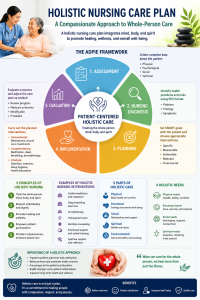
The Holistic nursing care plan is a modern approach to healthcare that focuses on treating the whole person, not just the disease. It combines physical, emotional, social, and spiritual care to improve overall patient wellbeing.
The Holistic nursing care plan is widely used in hospitals, clinics, and community health settings because it promotes personalized care and better recovery outcomes.
In modern healthcare, the Holistic nursing care plan integrates mind, body, and spirit to ensure patients receive complete and balanced care.
1. Understanding Assessment in Holistic Care
Assessment is the first and most important step in patient care. It involves collecting both subjective and objective data to understand the patient fully.
A strong Holistic nursing care plan begins with a deep and structured assessment of all aspects of a patient’s life, including physical, emotional, and social wellbeing.
Key areas of assessment include:
- Physical health (vital signs, nutrition, sleep)
- Emotional state (stress, anxiety, coping)
- Social support (family, environment)
- Spiritual beliefs and values
A well-done assessment ensures the Holistic nursing care plan is accurate and patient-centered.
2. Nursing Diagnosis and Problem Identification
After assessment, nurses identify the patient’s health problems using clinical judgment and standardized formats like PES (Problem, Etiology, Symptoms).
A Holistic nursing care plan ensures that diagnoses are not only medically accurate but also consider emotional and spiritual needs.
Common examples include anxiety, impaired mobility, and readiness for improved self-care.
This stage strengthens the foundation of the comprehensive nursing care plan by linking patient needs to appropriate interventions.
3. Planning for Patient-Centered Goals
Planning involves setting SMART goals and selecting appropriate interventions that match the patient’s condition and lifestyle.
A comprehensive nursing care plan ensures that goals are realistic, achievable, and tailored to the individual patient.
During planning, nurses work closely with patients to decide:
- Short-term and long-term goals
- Expected outcomes
- Suitable holistic and medical interventions
A structured Holistic nursing care plan improves communication and collaboration between nurses and patients.
4. Implementation of Holistic Interventions
Implementation is where planned care is put into action. Nurses apply both medical and complementary approaches.
A integrated nursing care plan includes medication administration, wound care, nutrition support, stress management, and lifestyle guidance.
Examples of implementation include:
- Deep breathing and relaxation exercises
- Meditation and mindfulness practices
- Patient education on healthy habits
A complete comprehensive nursing care plan ensures that every intervention supports total healing.
5. Evaluation and Outcome Review
Evaluation measures the success of the care provided and determines whether goals have been achieved.
A Holistic nursing care plan is continuously reviewed to ensure improvements in physical, emotional, and spiritual health.
If goals are not met, the care plan is adjusted to better suit the patient’s evolving needs.
Continuous evaluation ensures the Holistic nursing care plan remains effective and relevant.
Importance of Holistic Care in Nursing
The Holistic nursing care plan plays a critical role in modern healthcare by improving patient satisfaction and recovery rates. It promotes individualized care and strengthens the nurse-patient relationship.
A strong Holistic nursing care plan helps healthcare providers:
- Understand patients beyond symptoms
- Provide emotional and psychological support
- Improve treatment outcomes
- Encourage active patient participation
Healthcare systems increasingly rely on the Holistic nursing care plan to deliver high-quality and compassionate care.
Benefits of a Holistic Nursing Care Approach
The Holistic nursing care plan offers several benefits that improve both patient experience and healthcare delivery.
Some key benefits include:
- Faster recovery and healing
- Reduced stress and anxiety levels
- Improved patient engagement
- Better communication between nurse and patient
- Enhanced overall wellbeing
A properly designed Holistic nursing care plan ensures that patients feel valued, heard, and supported throughout their care journey.
SEO Optimization and Digital Healthcare Awareness
In today’s digital world, healthcare content must be optimized for search engines to reach more people.
A well-written Holistic nursing care plan article helps clinics, hospitals, and healthcare educators improve online visibility and attract more patients or learners.
To improve SEO performance:
- Use clear headings and structured content
- Maintain keyword relevance naturally
- Provide valuable, informative content
A properly optimized comprehensive nursing care plan page can rank higher on Google and increase healthcare awareness.
The Holistic nursing care plan is a powerful and patient-centered approach that transforms traditional nursing care into a more complete healing process. It focuses on treating the whole person and not just the illness.
By following structured steps like assessment, diagnosis, planning, implementation, and evaluation, healthcare professionals can deliver high-quality care that improves patient outcomes.
Ultimately, the nursing plan supports better health, stronger patient relationships, and more effective healthcare delivery.