
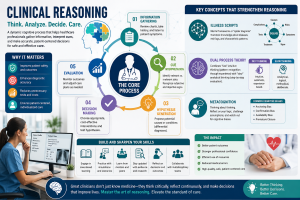
Healthcare professionals face complex situations every day that require accurate judgment and timely action. The ability to assess a patient’s condition, interpret information, and make informed decisions is essential for quality care. This is where clinical reasoning plays a vital role. It is a structured thinking process that helps healthcare providers understand patient needs, identify health problems, and determine the most appropriate interventions.
As healthcare systems become more advanced, the demand for strong analytical and decision-making skills continues to grow. Developing these skills not only improves patient outcomes but also reduces medical errors and enhances overall healthcare efficiency.
Understanding the Importance of Clinical Reasoning
Clinical reasoning is the process healthcare professionals use to collect information, analyze evidence, and make decisions regarding patient care. It combines theoretical knowledge, practical experience, critical thinking, and professional judgment.
Unlike simple memorization of facts, this approach requires practitioners to evaluate each patient’s unique situation. Every patient presents different symptoms, histories, and circumstances, making individualized assessment essential. Effective decision-making enables healthcare providers to respond appropriately while maintaining patient safety.
Strong reasoning skills support healthcare workers in identifying potential risks early, preventing complications, and delivering patient-centered care. These abilities are particularly valuable in fast-paced clinical environments where quick yet accurate decisions are required.
Key Steps in the Clinical Decision-Making Process
Healthcare professionals often follow a systematic approach when evaluating patient conditions. The process generally includes:
- Gathering patient information through history taking and assessment.
- Identifying relevant signs, symptoms, and clinical cues.
- Analyzing the collected data to determine possible causes.
- Formulating potential diagnoses or explanations.
- Selecting suitable interventions and treatment options.
- Evaluating outcomes and adjusting care plans when necessary.
This structured method ensures that decisions are based on evidence rather than assumptions. It also helps clinicians remain organized when managing complex cases.
Essential Concepts That Strengthen Clinical Practice
Several important concepts support effective clinical reasoning and improve professional performance.
Illness Scripts
Healthcare providers develop mental frameworks known as illness scripts. These frameworks store information about diseases, symptoms, risk factors, and warning signs. Over time, practitioners become better at recognizing patterns and connecting patient presentations to specific conditions.
Dual Process Thinking
Decision-making often relies on two complementary approaches:
- Fast thinking, which involves pattern recognition and intuition gained through experience.
- Slow thinking, which involves careful analysis and logical evaluation of available information.
Experienced professionals learn when to rely on intuition and when a more detailed assessment is necessary.
Reflective Practice
Reflection encourages clinicians to evaluate their own decisions and thought processes. By examining previous cases and outcomes, healthcare providers can identify areas for improvement and avoid repeating mistakes. This self-awareness contributes to better judgment and professional growth.
Benefits for Patients and Healthcare Organizations
The impact of strong reasoning skills extends beyond individual practitioners. Patients benefit from more accurate assessments, faster diagnoses, and personalized treatment plans. Healthcare organizations also gain advantages through improved efficiency and reduced costs.
Some key benefits include:
- Enhanced patient safety
- Improved diagnostic accuracy
- Better treatment planning
- Reduced unnecessary testing
- Lower healthcare costs
- Increased patient satisfaction
- Stronger professional confidence
These advantages demonstrate why healthcare institutions increasingly emphasize training in clinical reasoning as part of professional education and continuing development.
Building Strong Clinical Reasoning Skills
Developing expertise requires ongoing learning and practical experience. Healthcare professionals can strengthen their abilities through several strategies:
- Participating in case-based learning activities
- Engaging in simulation exercises
- Seeking mentorship from experienced clinicians
- Reviewing clinical evidence and research
- Practicing reflective thinking after patient encounters
- Collaborating with multidisciplinary healthcare teams
Continuous education allows practitioners to expand their knowledge while refining their ability to interpret clinical information effectively.
Modern healthcare environments require professionals who can adapt to changing situations and make informed decisions under pressure. Investing time in developing these competencies leads to improved patient care and better professional performance.
Clinical reasoning remains one of the most important skills in modern healthcare. It enables professionals to assess patient conditions accurately, interpret complex information, and make safe, evidence-based decisions. Through structured analysis, reflective practice, and continuous learning, healthcare providers can improve their ability to deliver high-quality care.
As healthcare challenges continue to evolve, the need for effective clinical reasoning will only become more significant. Organizations, educators, and healthcare professionals who prioritize these skills contribute to safer healthcare systems, better patient outcomes, and more efficient clinical practice. Strengthening this capability is an investment in both professional excellence and patient well-being.