
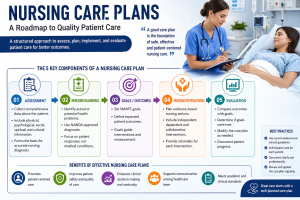
A nursing care plan is a structured clinical tool used by nurses to identify patient needs, set measurable outcomes, and deliver safe, individualized care. It connects assessment findings to nursing diagnoses and guides interventions based on evidence-based practice.
This guide breaks down exactly how to write a nursing care plan step by step, including real examples, templates, and common nursing diagnoses used in clinical and academic settings.
What is Nursing Care Plan
A nursing care plan is a structured, patient-centered document that guides nurses in delivering safe, effective, and evidence-based care. It serves as a roadmap for the nursing process by identifying a patient’s health needs, establishing measurable goals, planning interventions, and evaluating outcomes. Nursing care plans ensure that care is individualized to each patient’s condition, preferences, and circumstances while promoting consistency across healthcare settings.
The primary purpose of a nursing care plan is to improve patient outcomes through organized and coordinated care. By documenting assessment findings, nursing diagnoses, interventions, and expected results, nurses can provide targeted treatments that address both actual and potential health problems. Care plans also support evidence-based practice by encouraging the use of current clinical guidelines and research in decision-making.
In addition, nursing care plans help standardize nursing actions, ensuring that all healthcare professionals involved in a patient’s care understand the treatment goals and planned interventions. This improves communication, reduces the risk of errors, and promotes continuity of care during shifts, transfers, or discharge planning. Furthermore, nursing care plans support critical thinking and clinical decision-making by helping nurses prioritize patient needs and evaluate the effectiveness of interventions. As a result, they remain an essential tool in delivering high-quality, patient-focused nursing care in both academic and clinical environments.
Creating Comprehensive Nursing Care Plans That Meet Academic and Clinical Standards
Nursing Care Plans are essential tools that guide patient-centered care and support clinical decision-making. They provide a structured framework for assessing patient needs, identifying health concerns, setting measurable goals, implementing interventions, and evaluating outcomes. In nursing education, care plans are equally important because they demonstrate a student’s ability to apply theoretical knowledge to real-world clinical situations.
Developing high-quality Nursing Care Plans requires critical thinking, evidence-based practice, and a clear understanding of patient care priorities. Whether for academic assignments or clinical placements, a well-developed care plan reflects professional nursing standards and contributes to improved patient outcomes. Students often seek Nursing Assignment Help to strengthen their care planning skills and ensure their assignments meet institutional expectations.
Importance of Nursing Care Plans
Nursing care plans play a vital role in delivering safe, effective, and patient-centered healthcare. They provide a structured approach to assessing patient needs, planning interventions, and evaluating outcomes, ensuring that care is organized and consistent. One of the key benefits of a nursing care plan is its ability to reduce clinical errors by clearly documenting patient information, nursing diagnoses, goals, and interventions. This helps nurses make informed decisions and minimizes the risk of omissions or misunderstandings during care delivery.
Nursing care plans also improve communication among healthcare professionals by providing a shared reference point for patient care. When nurses, physicians, therapists, and other team members have access to the same care plan, collaboration becomes more efficient, resulting in better coordinated care. Additionally, care plans serve as important legal documents that demonstrate the care provided, clinical reasoning, and adherence to professional standards, which can be valuable in quality assurance and legal situations.
Another significant advantage is that nursing care plans promote holistic patient care by addressing physical, psychological, social, cultural, and emotional needs rather than focusing solely on medical conditions. This comprehensive approach supports improved patient outcomes and satisfaction. Furthermore, nursing care plans align with recognized nursing standards, frameworks, and evidence-based practice guidelines, ensuring that care remains professional, accountable, and focused on achieving the best possible health outcomes. For these reasons, nursing care plans remain a cornerstone of modern nursing practice.
The Nursing Process (ADPIE Framework)
The ADPIE framework is the foundation of every nursing care plan and provides a systematic approach to delivering high-quality patient care. ADPIE stands for Assessment, Diagnosis, Planning, Implementation, and Evaluation, which are the five essential steps nurses follow to identify patient needs, develop care strategies, and measure outcomes. Using the nursing process ensures that care remains organized, evidence-based, and focused on achieving the best possible patient outcomes.
The first step, Assessment, involves collecting both subjective and objective data about the patient. Subjective data includes information reported by the patient, such as symptoms, pain levels, or concerns, while objective data consists of measurable findings like vital signs, laboratory results, and physical examination findings.
The second step, Diagnosis, focuses on identifying nursing problems based on assessment findings. Nurses use standardized NANDA nursing diagnoses to describe patient responses to actual or potential health conditions and to guide appropriate interventions.
During Planning, nurses establish SMART goals that are specific, measurable, achievable, relevant, and time-bound. These goals provide clear targets for patient care and recovery.
The Implementation phase involves carrying out nursing interventions designed to achieve the planned outcomes. Interventions may include administering medications, monitoring patient status, providing education, or coordinating care with other healthcare professionals.
Finally, Evaluation determines whether the established goals have been met. Nurses assess patient progress, review outcomes, and modify the nursing care plan when necessary to ensure ongoing, effective, and patient-centered care.
Components of a Nursing Care Plan
A comprehensive nursing care plan consists of several essential components that work together to guide patient-centered care and improve health outcomes. Each element plays a specific role in ensuring that nursing interventions are evidence-based, measurable, and tailored to the individual needs of the patient.
The first component is patient assessment data, which includes both subjective and objective information gathered during the assessment phase. This may involve patient-reported symptoms, medical history, physical examination findings, vital signs, and diagnostic test results. Accurate assessment data provides the foundation for all subsequent clinical decisions.
The second component is the nursing diagnosis, typically based on standardized NANDA-I nursing diagnoses. A nursing diagnosis identifies actual or potential health problems that nurses can address through independent nursing interventions. It helps prioritize patient needs and directs the focus of care.
The care plan should also include clearly defined goals and expected outcomes, often guided by the Nursing Outcomes Classification (NOC). These outcomes should be specific, measurable, achievable, relevant, and time-bound to enable effective evaluation of patient progress.
Another key component is nursing interventions, which may be informed by the Nursing Interventions Classification (NIC). These interventions outline the specific actions nurses will take to achieve the desired outcomes.
Each intervention should be supported by a rationale, explaining why the action is necessary and how it contributes to patient recovery or wellbeing. Finally, evaluation criteria are included to determine whether the goals have been achieved and whether modifications to the care plan are required. Together, these components create a structured framework for delivering safe, effective, and individualized nursing care.
How to Write a Nursing Care Plan (Step-by-Step)
Writing a nursing care plan involves a systematic approach that ensures patient care is individualized, evidence-based, and focused on achieving positive health outcomes. By following the nursing process, nurses can identify patient needs, prioritize interventions, and evaluate the effectiveness of care.
Step 1: Collect Patient Data
The first step in developing a nursing care plan is gathering comprehensive patient information. This includes collecting both subjective and objective data through patient interviews, physical assessments, and diagnostic investigations. Important information may include vital signs, presenting symptoms, medical history, medication use, laboratory results, and diagnostic test findings. Accurate assessment data forms the foundation of the nursing care plan and supports clinical decision-making.
Step 2: Identify Nursing Diagnoses
After collecting assessment data, nurses analyze the information to identify actual or potential health problems. Nursing diagnoses are typically based on standardized NANDA-I classifications and focus on patient responses to illness or health conditions rather than medical diagnoses. Examples include impaired gas exchange, acute pain, risk for infection, and impaired mobility. Correctly identifying nursing diagnoses helps nurses prioritize patient care needs and select appropriate interventions.
Step 3: Set SMART Goals
Once nursing diagnoses have been established, measurable goals and expected outcomes should be developed. Goals should follow the SMART framework, meaning they are specific, measurable, achievable, relevant, and time-bound. For example, a suitable goal may be: “The patient will maintain an oxygen saturation level above 95% within 24 hours.” Well-defined goals provide clear direction for nursing care and facilitate outcome evaluation.
Step 4: Plan Nursing Interventions
The next step is to determine the nursing interventions required to achieve the established goals. Interventions should be evidence-based, patient-centered, and appropriate for the identified nursing diagnosis. Examples include monitoring oxygen saturation every four hours, administering oxygen therapy as prescribed, encouraging deep breathing exercises, and providing patient education. Each intervention should be supported by a clear clinical rationale.
Step 5: Implement Care
Implementation involves carrying out the planned nursing interventions safely and effectively. Nurses must perform interventions according to professional standards, collaborate with other healthcare professionals when necessary, and accurately document all care provided. Effective implementation promotes patient safety and supports continuity of care.
Step 6: Evaluate Outcomes
The final step is evaluation. Nurses assess whether the patient has achieved the planned goals and expected outcomes. If goals are not met, the nursing care plan should be reviewed and modified based on the patient’s current condition. Continuous evaluation ensures that care remains effective, responsive, and focused on improving patient outcomes and overall wellbeing.
Here is a 600-word SEO-friendly section with a mix of paragraphs and bullet points:
Nursing Diagnoses (NANDA Examples)
A nursing diagnosis is a clinical judgment about an individual, family, or community’s response to actual or potential health problems. Unlike a medical diagnosis, which focuses on a disease or condition, a nursing diagnosis focuses on how the patient responds to that condition and identifies issues that can be addressed through nursing interventions. The use of NANDA International (NANDA-I) nursing diagnoses provides a standardized language that helps nurses communicate effectively, develop appropriate care plans, and improve patient outcomes.
A well-written nursing diagnosis should be:
- Evidence-based and supported by assessment findings.
- Patient-specific rather than generic.
- Measurable to allow evaluation of outcomes.
- Relevant to the patient’s current health status.
- Action-oriented to guide nursing interventions.
The following are some of the most commonly used nursing diagnoses in clinical practice.
Acute Pain
Acute pain refers to an unpleasant sensory and emotional experience associated with actual or potential tissue damage. It is often sudden in onset and usually resolves once the underlying cause is treated.
Common assessment findings include:
- Patient reports pain or discomfort.
- Increased heart rate or blood pressure.
- Facial grimacing or guarding behaviors.
- Reduced mobility due to pain.
Example nursing diagnosis:
Acute pain related to surgical incision as evidenced by patient-reported pain score of 8/10 and limited movement.
Ineffective Airway Clearance
This diagnosis is used when a patient is unable to clear secretions or obstructions from the respiratory tract effectively.
Common signs include:
- Shortness of breath.
- Abnormal breath sounds.
- Excessive mucus production.
- Decreased oxygen saturation levels.
Example nursing diagnosis:
Ineffective airway clearance related to excessive secretions as evidenced by productive cough and oxygen saturation of 90%.
Risk for Infection
Patients may be at increased risk of infection due to invasive procedures, weakened immunity, chronic illness, or wounds. This diagnosis focuses on preventing complications before they occur.
Risk factors may include:
- Surgical incisions.
- Indwelling urinary catheters.
- Intravenous lines.
- Immunosuppressive therapy.
Example nursing diagnosis:
Risk for infection related to compromised skin integrity and surgical wound.
Impaired Mobility
Impaired mobility occurs when a patient experiences limitations in independent movement. This can result from injury, surgery, neurological disorders, pain, or muscle weakness.
Assessment findings may include:
- Difficulty walking.
- Reduced range of motion.
- Need for mobility aids.
- Dependence on caregivers for movement.
Example nursing diagnosis:
Impaired physical mobility related to lower limb weakness as evidenced by inability to walk independently.
Deficient Fluid Volume
Deficient fluid volume refers to decreased intravascular, interstitial, or intracellular fluid levels. Early identification is essential to prevent serious complications.
Common indicators include:
- Dry mucous membranes.
- Hypotension.
- Increased heart rate.
- Reduced urine output.
- Poor skin turgor.
Example nursing diagnosis:
Deficient fluid volume related to excessive vomiting and diarrhea as evidenced by dehydration and low blood pressure.
Anxiety
Anxiety is a common nursing diagnosis that affects patients experiencing uncertainty, illness, hospitalization, or major life changes. Unmanaged anxiety can negatively impact recovery and overall wellbeing.
Signs and symptoms may include:
- Restlessness.
- Excessive worrying.
- Difficulty concentrating.
- Increased heart rate.
- Sleep disturbances.
Example nursing diagnosis:
Anxiety related to hospitalization and uncertainty about treatment outcomes as evidenced by verbalized fear and restlessness.
Key Considerations When Formulating Nursing Diagnoses
When developing nursing diagnoses, nurses should use comprehensive assessment data and clinical judgment to ensure accuracy. Every diagnosis should be supported by objective and subjective evidence and linked to realistic patient outcomes. Using standardized NANDA-I terminology promotes consistency in documentation and communication across healthcare settings. Effective nursing diagnoses form the foundation of a successful nursing care plan, guiding interventions, supporting clinical decision-making, and ultimately contributing to improved patient safety, quality of care, and positive health outcomes.
Key Components of Effective Nursing Care Plans
Creating comprehensive Nursing Care Plans involves several interconnected components. Each section must be completed accurately and logically to ensure the plan aligns with academic and clinical requirements.
The core elements include:
- Comprehensive patient assessment
- Nursing diagnosis identification
- Goal and outcome development
- Evidence-based nursing interventions
- Rationales for interventions
- Evaluation of patient outcomes
A thorough assessment serves as the foundation of the entire care plan. Nurses collect subjective and objective data, including medical history, symptoms, laboratory findings, and physical examination results. This information helps identify actual and potential health problems that require nursing intervention.
Conducting Accurate Patient Assessments
A successful care plan begins with a detailed patient assessment. This stage involves gathering relevant information to understand the patient’s physical, psychological, social, and emotional needs.
When developing Nursing Care Plans, students should focus on:
- Vital signs and physical observations
- Patient complaints and symptoms
- Medical and surgical history
- Medication usage
- Lifestyle and environmental factors
- Psychosocial considerations
Accurate assessment data enables nursing students to make informed clinical judgments and develop targeted interventions. In Nursing Assignment Writing, assessment findings should be presented clearly and supported by clinical evidence whenever possible.
Formulating Appropriate Nursing Diagnoses
After collecting assessment data, the next step is identifying nursing diagnoses. A nursing diagnosis differs from a medical diagnosis because it focuses on the patient’s response to health conditions rather than the disease itself.
Strong nursing diagnoses should be:
- Evidence-based
- Patient-centered
- Specific and measurable
- Relevant to assessment findings
Examples include impaired mobility, acute pain, risk for infection, ineffective breathing patterns, and anxiety. Selecting accurate diagnoses demonstrates clinical reasoning and is a critical requirement in Nursing Assignment Writing services designed to support academic success.
A well-formulated nursing diagnosis provides direction for the remainder of the care plan and ensures interventions address the patient’s most pressing needs.
Setting Realistic Goals and Expected Outcomes
Goals and expected outcomes are vital elements of Nursing Care Plans because they establish the desired results of nursing interventions. Effective goals should follow the SMART framework:
- Specific
- Measurable
- Achievable
- Relevant
- Time-bound
For example, instead of writing “patient will improve,” a stronger goal would be “patient will report pain levels below 3 out of 10 within 48 hours of intervention.”
Clearly defined outcomes help healthcare professionals evaluate patient progress and determine whether nursing interventions are effective. Academic instructors also assess the quality of care plans based on the relevance and measurability of established goals.
Implementing Evidence-Based Nursing Interventions
Nursing interventions are the actions nurses perform to achieve established goals and improve patient outcomes. These interventions should be grounded in current research, clinical guidelines, and professional nursing standards.
Common categories of nursing interventions include:
- Assessment interventions
- Therapeutic interventions
- Educational interventions
- Preventive interventions
- Collaborative interventions
Each intervention should be accompanied by a rationale explaining why the action is necessary. Rationales demonstrate critical thinking and show how nursing actions contribute to patient recovery and well-being.
Students who struggle with intervention selection often benefit from a Nursing Assignment assistant that provides guidance on evidence-based practices and proper care plan structure.
Evaluating Patient Outcomes Effectively
Evaluation is the final stage of care plan development and determines whether patient goals have been achieved. This step requires nurses to compare actual outcomes with expected outcomes and make adjustments when necessary.
Effective evaluation involves:
- Reviewing patient progress
- Assessing intervention effectiveness
- Identifying barriers to recovery
- Modifying care plans when required
- Documenting findings accurately
Evaluation demonstrates the dynamic nature of Nursing Care Plans and highlights the importance of continuous patient monitoring. Academic care plans should clearly explain how outcomes will be measured and assessed over time.
Real Nursing Care Plan Example
A nursing care plan provides a structured approach to managing patient health problems and ensuring that care is evidence-based, individualized, and outcome-focused. The following example demonstrates how the nursing process can be applied to a patient diagnosed with pneumonia.
Patient Case
A 65-year-old patient is admitted to the hospital with community-acquired pneumonia. The patient presents with a persistent cough, fever of 38.8°C, shortness of breath, fatigue, and increased mucus production. On assessment, the patient has a respiratory rate of 26 breaths per minute and an oxygen saturation level of 91% on room air. Auscultation reveals crackles in both lower lung fields, indicating the presence of respiratory secretions.
Assessment Data
Subjective Data:
- Reports difficulty breathing.
- Complains of chest discomfort when coughing.
- States feeling tired and weak.
Objective Data:
- Temperature: 38.8°C.
- Respiratory rate: 26 breaths per minute.
- Oxygen saturation: 91%.
- Productive cough with thick sputum.
- Crackles heard on lung auscultation.
Nursing Diagnosis
Ineffective Airway Clearance related to mucus buildup secondary to pneumonia as evidenced by productive cough, abnormal breath sounds, shortness of breath, and decreased oxygen saturation.
This nursing diagnosis focuses on the patient’s inability to effectively clear respiratory secretions, which may impair gas exchange and increase the risk of complications.
Goal
The patient will maintain a clear airway and achieve an oxygen saturation level above 94% within 48 hours of nursing interventions.
Expected Outcomes
- Respiratory rate will return to normal range.
- Oxygen saturation will remain above 94%.
- Lung sounds will improve with reduced crackles.
- The patient will demonstrate effective coughing and secretion clearance.
- Shortness of breath will decrease.
Nursing Interventions and Rationales
1. Monitor respiratory rate, oxygen saturation, and lung sounds regularly.
- Rationale: Continuous assessment helps identify changes in respiratory status and evaluates the effectiveness of treatment.
2. Encourage deep breathing and coughing exercises every two hours.
- Rationale: Deep breathing promotes lung expansion, while coughing helps mobilize and remove secretions from the airways.
3. Administer prescribed antibiotics as ordered by the healthcare provider.
- Rationale: Antibiotics treat the underlying bacterial infection, reducing inflammation and mucus production.
4. Position the patient in a semi-Fowler’s position.
- Rationale: Elevating the head of the bed promotes lung expansion and improves breathing efficiency.
5. Encourage adequate fluid intake if not contraindicated.
- Rationale: Hydration helps thin respiratory secretions, making them easier to expectorate.
Implementation
All planned interventions are carried out according to clinical guidelines and documented appropriately. The nurse monitors the patient’s response to treatment, reinforces breathing exercises, administers medications safely, and collaborates with the healthcare team to support recovery.
Evaluation
After 48 hours of treatment, the patient’s oxygen saturation increases to 95%, respiratory rate decreases to 20 breaths per minute, and coughing becomes more effective. Lung sounds show improvement, and the patient reports reduced shortness of breath. Based on these findings, the goal has been achieved, demonstrating that the nursing interventions were effective in improving airway clearance and respiratory function.
Common Challenges in Nursing Care Plan Development
Many nursing students encounter difficulties when creating comprehensive care plans. These challenges often affect assignment quality and academic performance.
Common obstacles include:
- Limited understanding of nursing diagnoses
- Difficulty linking assessments to interventions
- Inadequate clinical reasoning skills
- Poor documentation practices
- Lack of evidence-based references
Addressing these challenges requires consistent practice, clinical exposure, and access to reliable learning resources. Professional Nursing Assignment Help can provide valuable support for students seeking to improve their care planning abilities and achieve better academic results.
Best Practices for Academic and Clinical Success
To create Nursing Care Plans that meet both academic and clinical standards, students should follow established best practices throughout the planning process.
Recommended strategies include:
- Use current evidence-based literature
- Follow institutional guidelines carefully
- Prioritize patient-centered care
- Maintain clear and professional documentation
- Support interventions with strong rationales
- Review and revise plans regularly
Additionally, students should ensure their work demonstrates critical thinking rather than simply listing interventions. High-quality Nursing Assignment Writing reflects a deep understanding of patient needs, clinical priorities, and professional nursing responsibilities.
Developing effective Nursing Care Plans is a fundamental skill that bridges classroom learning and clinical practice. Comprehensive care plans support safe, patient-centered care while demonstrating a nursing student’s ability to assess, diagnose, plan, implement, and evaluate healthcare interventions. By conducting detailed assessments, formulating accurate nursing diagnoses, establishing measurable goals, implementing evidence-based interventions, and evaluating outcomes, students can create care plans that meet academic and clinical standards. For those seeking additional support, Nursing Assignment Writing services, a Nursing Assignment assistant, and professional Nursing Assignment Help can provide valuable guidance in mastering care plan development and achieving academic excellence in nursing education.
Frequently Asked Questions (FAQs)
1. What is a nursing care plan?
A nursing care plan is a structured document that outlines patient assessment, nursing diagnoses, goals, interventions, and evaluation. It guides nurses in delivering safe, individualized, and evidence-based care.
2. Why are nursing care plans important?
Nursing care plans improve patient outcomes by ensuring organized care, reducing errors, enhancing communication among healthcare teams, and supporting clinical decision-making and legal documentation.
3. What is included in a nursing care plan?
A complete nursing care plan includes:
- Patient assessment data
- Nursing diagnosis (NANDA-I)
- Goals and expected outcomes (NOC)
- Nursing interventions (NIC)
- Rationale for interventions
- Evaluation criteria
4. What is ADPIE in nursing?
ADPIE stands for:
- Assessment
- Diagnosis
- Planning
- Implementation
- Evaluation
It is the core nursing process used to develop and guide care plans.
5. What is a nursing diagnosis?
A nursing diagnosis is a clinical judgment about a patient’s response to health conditions or life processes. It guides nursing interventions rather than medical treatment.
6. What are examples of nursing diagnoses?
Common examples include:
- Acute pain
- Ineffective airway clearance
- Risk for infection
- Impaired mobility
- Deficient fluid volume
- Anxiety
7. What is the difference between a nursing diagnosis and a medical diagnosis?
A medical diagnosis identifies a disease (e.g., pneumonia), while a nursing diagnosis focuses on patient responses (e.g., ineffective airway clearance).
8. How do you write SMART goals in a care plan?
SMART goals are:
- Specific
- Measurable
- Achievable
- Relevant
- Time-bound
Example: “Patient will maintain oxygen saturation above 95% within 24 hours.”
9. What are nursing interventions?
Nursing interventions are actions taken by nurses to achieve patient goals, such as monitoring vital signs, administering medication, and providing patient education.
10. Who uses nursing care plans?
Nursing care plans are used by registered nurses, student nurses, healthcare teams, and educators in clinical and academic settings to ensure safe and effective patient care.