
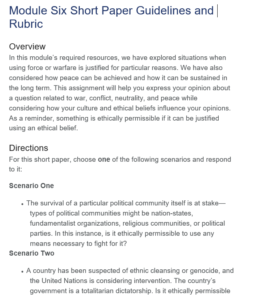
Scenario One
- The survival of a particular political community itself is at stake—types of political communities might be nation-states, fundamentalist organizations, religious communities, or political parties. In this instance, is it ethically permissible to use any means necessary to fight for it?
Scenario Two
- A country has been suspected of ethnic cleansing or genocide, and the United Nations is considering intervention. The country’s government is a totalitarian dictatorship. Is it ethically permissible to impose democracy on an undemocratic regime? Why, or why not?
Specifically, you must address the following:
- Ethically Permissible: Explain why the action proposed in your chosen scenario is or is not ethically permissible.
- Culture: Describe how your culture influences your opinion about this scenario.
- Ethical Beliefs: Explain how your personal ethical beliefs influence your opinion about this scenario.
How to complete this nursing assignment and what to write in each section
In this assignment, you will be asked to select one of the scenarios and justify the ethically permissibility of the described action as well as comment on how culture and personal ethical beliefs would affect your decision. The paper must be 12-14 pages, double-spaced, Times New Roman 12-point font and one-inch margins. Because you do not need to use sources in the assignment, you should concentrate on your own arguments, principles, and worldview. To accomplish the assignment successfully, divide your paper into four major parts: introduction, ethical permissibility, cultural influence, and ethical beliefs, and make a brief conclusion.
1. Choose One Scenario
- The initial action is to pick one of the two scenarios that are given in the assignment instructions.
- Scenario One: The existence of a political community is under threat, and the question is whether it is ethically justified to employ any means, including extreme or violent ones.
- Scenario Two: An alleged genocidal country is under the rule of a dictatorship and the question is whether the international community has a moral right to intervene and bring democracy.
- Select the scenario that you are most comfortable talking about. It is important to make a definite choice before writing whether you think that the action is ethically permissible or not since all your argument will be in favor of this choice.
2. Compose the Introduction (About 120 – 150 Words)
Begin the paper with a brief introduction that presents the issue of war, conflict and ethical decision-making. Next describe the situation you have chosen in a few words and mention your overall opinion.
There are three things that you need to put in your introduction:
A short explanation of the emergence of ethical issues in war or political conflict.
Brief description of the situation you have chosen.
An explicit thesis statement that the action is ethically acceptable or not and why.
Example structure:
- Sentence 1-2: Present the concept that war and political conflict brings about ethical issues.
- Sentence 3-4: Summarize the situation.
- Sentence 5: Express your central position.
Your thesis should clearly answer the assignment question.
3. Discuss Ethical Permissibility (Approx. 250 – 300 Words)
This is the critical part of the paper since it directly responds to the assignment question.
In this part you need to justify why the action in the scenario is ethically permissible or not ethically permissible. Justify your answer with the following ethical concepts:
- Human rights
- Safety of innocent individuals.
- Self-defense
- Just war principles
- Limits of violence
- Respect for sovereignty
- Consequences of military intervention
Give a logical explanation. Avoid only stating your opinion; instead, justify it with clear reasoning.
For example:
In case you select Scenario One, explain whether or not the survival of a community is a reason to go to extreme measures and whether or not there are limits to war.
In case you select Scenario Two, debate on whether international intervention and imposing political change is warranted by the need to protect the victims of genocide.
Structure this section in the following way:
- Paraphrase the ethical question.
- Make your stand.
- Give two or three reasons in favor of your opinion.
- Briefly explain the possible consequences of the action.
This part is to demonstrate that you know about the ethical issue and can present your opinion rationally.
4. Explain Cultural Influence (About 200 Words)
The following section of the paper ought to describe the role of your culture in your opinion.
Culture consists of values, traditions, religious beliefs, historical experiences, and social norms. Consider how your upbringing in the society or the environment influences your perception of conflict, violence and political intervention.
To write this section, ask yourself questions such as:
- Is my culture a culture of peace, diplomacy or negotiation?
- Does my culture focus on justice, human rights, or protection of vulnerable individuals?
- Has my culture gone through war, colonialism or political oppression and how people perceive foreign intervention?
- Is my culture more community-oriented or individual-oriented?
Explain certain cultural values that influence your worldview.
E.g., you can say that your culture believes in peaceful conflict resolution and so you are hesitant to intervene in a military conflict or that your culture believes in safeguarding human rights and so you would intervene in genocide.
Concentrate on how culture influences your thinking, not simply explaining what culture is.
5. Discuss Personal Ethical Beliefs (Approximately 180-200 Words)
The second part is to concentrate on your own ethical beliefs that could be informed by philosophy, religion, education or experiences in life.
Discuss your ethical principles that inform your reasoning. Examples include:
- Faith in human dignity and equality.
- Significance of saving innocent lives.
- Devotion to justice and responsibility.
- Confidence in non-violent solutions.
- Endorsement of international collaboration.
Discuss the impact of these beliefs on your opinion of the scenario.
For instance:
In case you think that it is a moral responsibility to protect innocent people, then you may advocate intervention in genocide.
In case you feel that violence should be the last resort, you might be against extreme military action.
Ensure that you relate your moral values to your stand in the situation. The idea is to demonstrate how your values influence your opinion regarding what is morally right.
6. Short Conclusion (Approximately 80 – 100 Words)
Conclude the paper with a short conclusion of your key points.
Your conclusion should:
Paraphrase the ethical problem.
Summarize your opinion.
Include how culture and ethical beliefs impacted your thinking.
Do not present new ideas in the conclusion. Just strengthen the point that you have made.
7. Final Formatting Checklist
Prior to handing in the assignment, ensure that your paper is formatted accordingly:
- 800 words total
- Microsoft Word document
- Times New Roman font of 12 points.
- Double spaced
- One-inch margins
- Clear paragraphs
- Organized sections
- No sources needed unless you want to include them.
Also read the paper to check on clarity, grammar and logical flow as part of the grading rubric is clear communication.
Final Tip
To score all the points, the most important thing is to ensure that your paper has tackled all the three criteria in the rubric:
- Explain ethical permissibility
- Describe cultural influence
- Demonstrate personal ethical beliefs.
As long as every section is well written and well structured, your paper will be up to the standard of the assignment.